eFluorination
Electrochemical deoxyfluorination of activated alcohols, decarboxyfluorination of carboxylic acids, and routes to carbamoyl fluorides, fluorothioformates, thiocarbamoyl fluorides and N-trifluoromethyl amines.
Related publications
From mechanistic insight to reproducible synthesis in batch and flow.
Many valuable transformations rely on radicals, carbocations, carbanions, diazo species or other high-energy intermediates that are difficult to store or handle. We use electron transfer at the electrode to generate these species only when needed, close to the electrode and at low concentration.
We design reactions in which a suitable reaction partner captures the intermediate as it forms. Productive capture can limit its steady-state concentration and reduce the opportunity for decomposition or competing pathways.
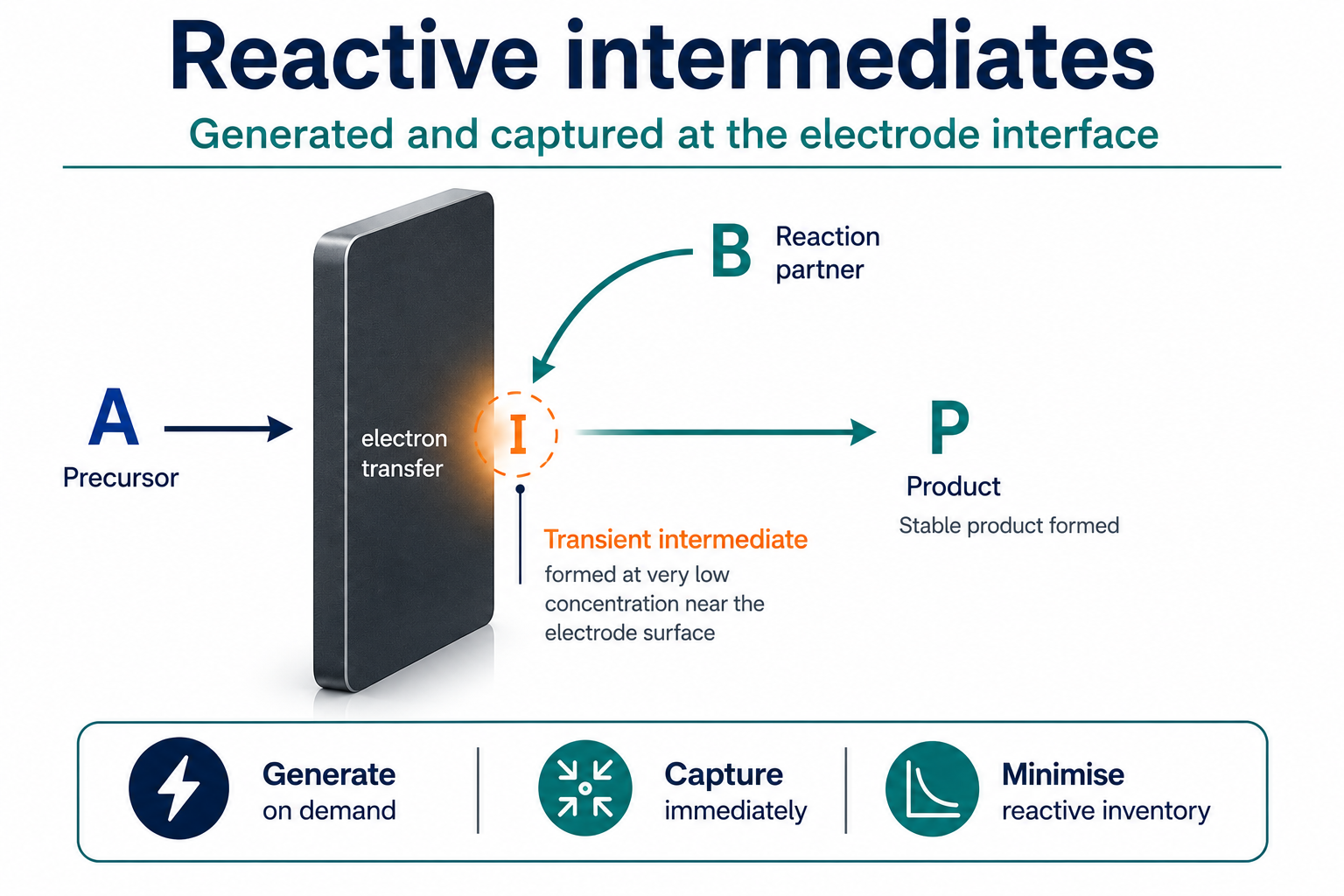
Use electrical input to control when the intermediate is formed.
Position the reaction partner so productive chemistry competes with decomposition.
Avoid accumulating a large concentration of the transient species.
Mechanistic assignments are based on converging evidence rather than any single experiment. We combine cyclic voltammetry and related electroanalytical measurements with DigiSim fitting, benchtop NMR, UV–Vis spectroscopy and density functional theory.
DigiSim is used to test whether candidate kinetic schemes reproduce the experimental voltammograms. Spectroscopy probes intermediates, speciation and concentration changes. DFT evaluates structures, redox energetics and reaction barriers.
Candidate pathways are tested against the available electroanalytical, spectroscopic, kinetic and computational evidence, with uncertainties and alternative interpretations stated explicitly.
The objective is an evidence-supported mechanism that can guide potential, current, electrode material, reagent concentration, reaction time and selectivity.
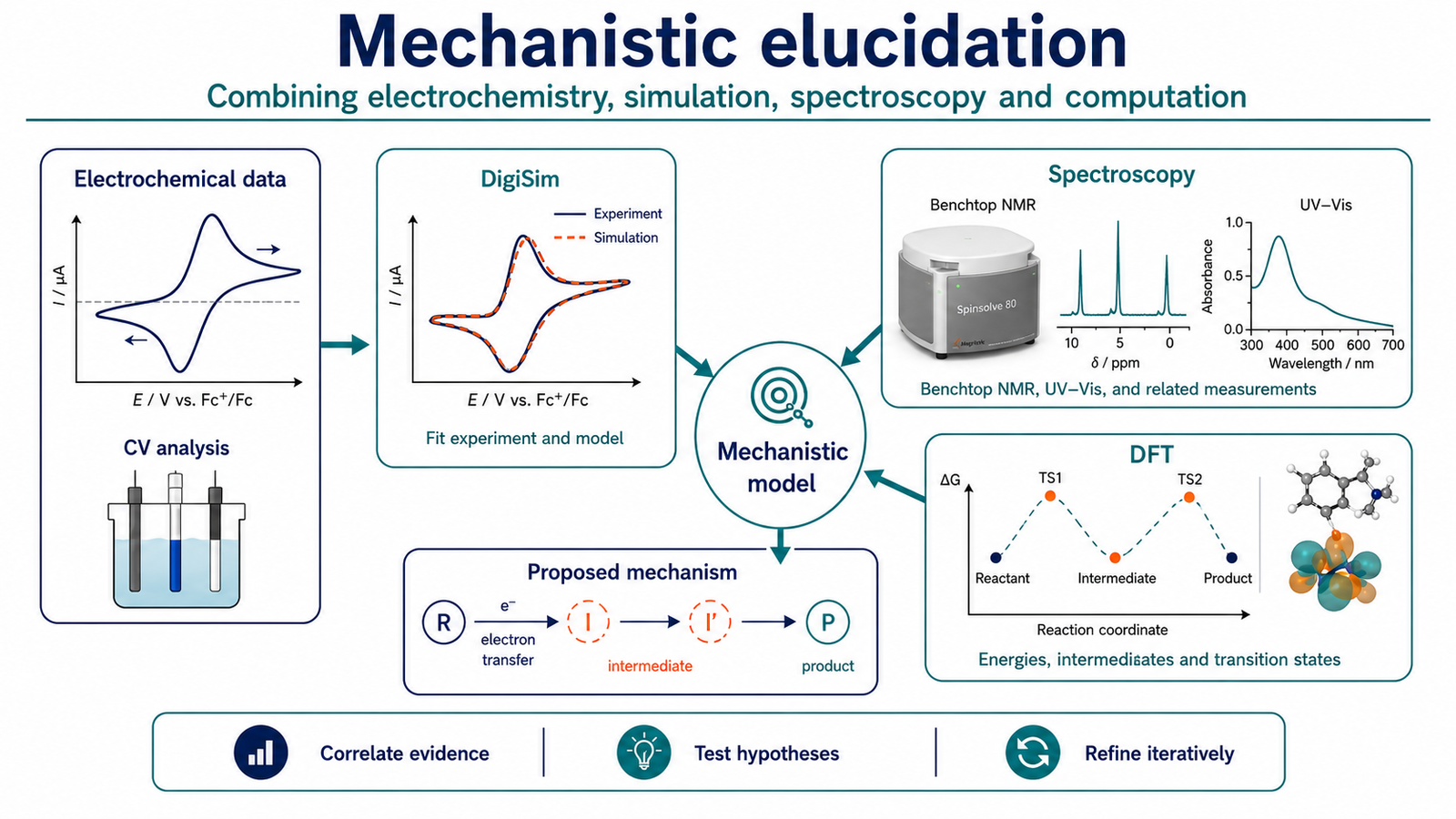
Interpret electroanalysis, spectroscopy, simulation and computation together.
Ask whether a proposed kinetic scheme is consistent with the available evidence.
Use disagreement between model and experiment to improve the mechanism.
Batch discovery is only the starting point. We develop and optimise reactions at milligram scale using the ElectraSyn 2.0, then translate promising processes to continuous flow using dedicated equipment, including the CRD Ammonite 8 flow cell.
Flow translation is treated as a separate engineering problem, not as a larger version of the batch experiment. Current density, electrode material, electrode spacing, electrolyte, concentration, flow rate, residence time, mass transfer and heat management must all be reconsidered.
The goal is reproducible gram-scale and larger production with controlled selectivity, higher throughput and limited reactive inventory.
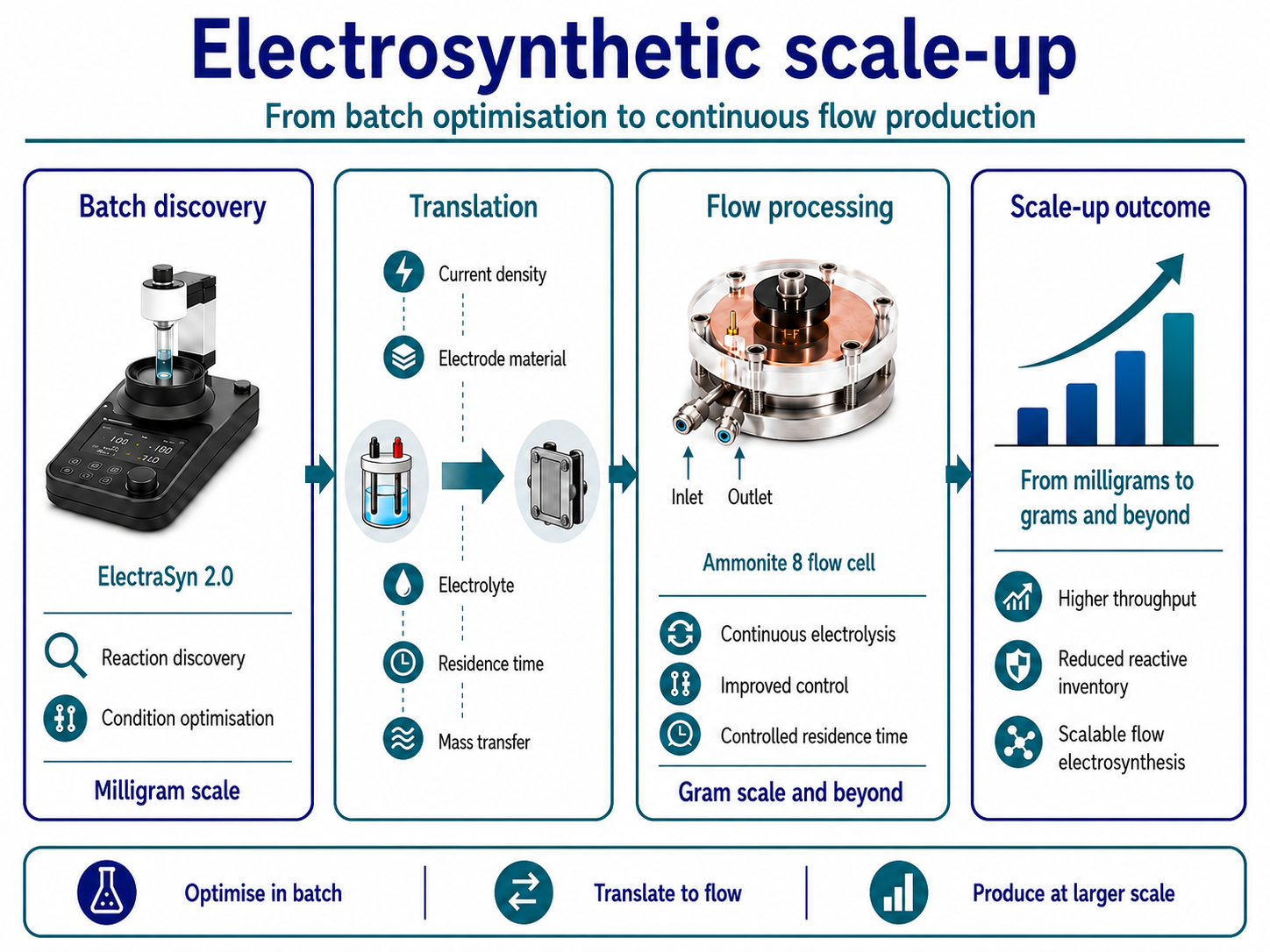
Establish the transformation and its electrochemical operating window.
Preserve current density, residence time and transport behaviour.
Control throughput and reaction exposure in continuous processing.
DualFlow investigates a hybrid energy-storage and conversion platform. In battery mode, redox mediators circulate through a flow-battery cell and store renewable electricity. Once charged, the positive and negative electrolytes can be diverted to separate external reactors.
The oxidised positive-side mediator drives chemical oxidation, while the reduced negative-side mediator produces hydrogen at a catalytic surface. The discharged mediators return to their electrolyte tanks. Separating mediator charging from product formation allows the hydrogen and chemical reactors to be controlled and dimensioned independently.
The Lam Research Group contributes expertise in mediated organic oxidation, synthetic method development and the translation of chemical reactions into reactor-compatible processes.
The project is coordinated by the University of Turku and brings together expertise in flow batteries, catalysis, organic electrosynthesis, interfacial chemistry and bioproducts. The current consortium is listed on the official CORDIS record.
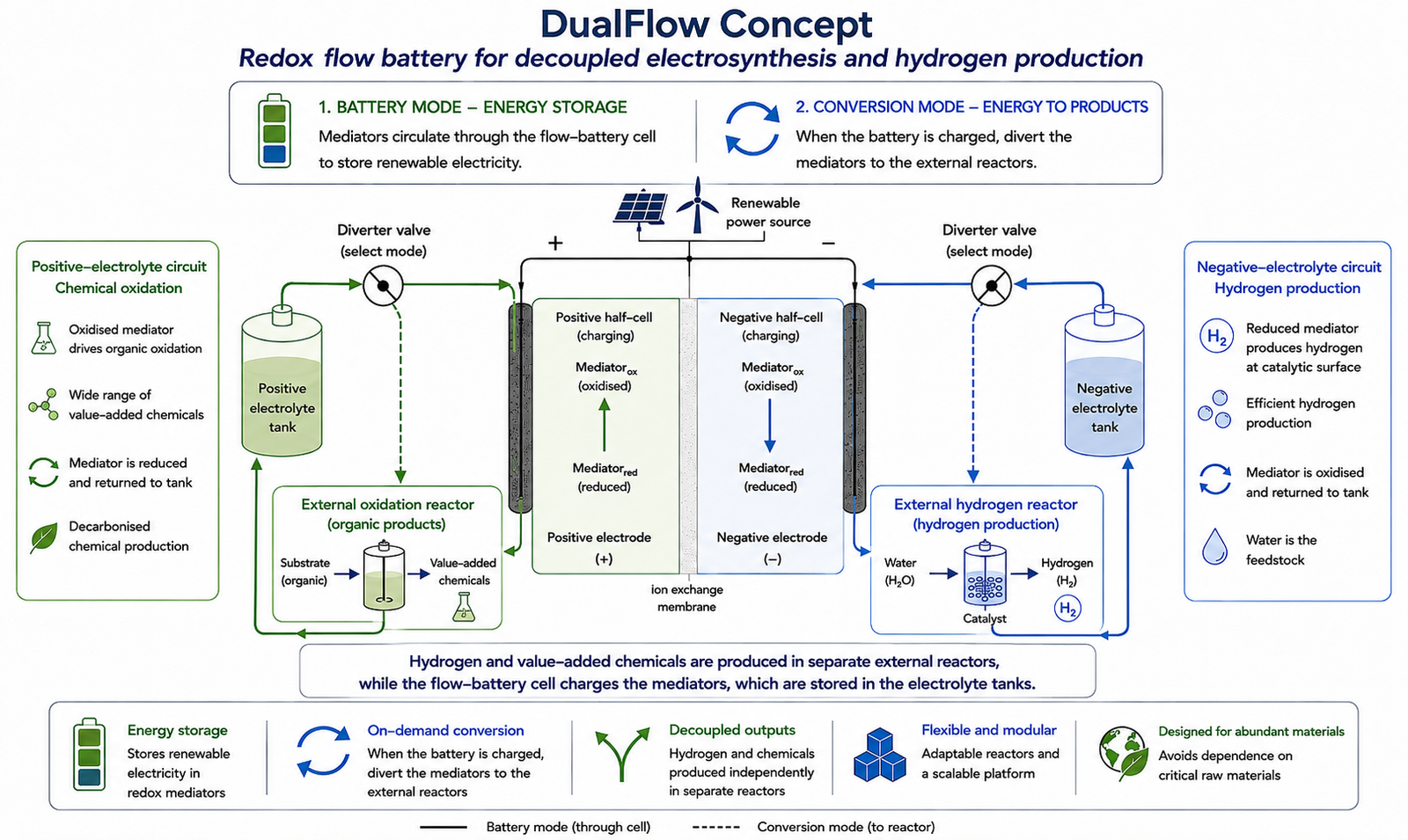
Charge circulating redox mediators in the flow-battery cell.
Divert charged mediators to product-forming external reactors.
Control chemical production and hydrogen generation independently.
The broader principles above are demonstrated through specific reaction families. Each platform connects a defined synthetic problem with electrochemical control, mechanistic evidence and, where appropriate, process translation.
Electrochemical deoxyfluorination of activated alcohols, decarboxyfluorination of carboxylic acids, and routes to carbamoyl fluorides, fluorothioformates, thiocarbamoyl fluorides and N-trifluoromethyl amines.
Related publications
Electrochemical generation of electrophilic and nucleophilic cyanating species from defined precursor reagents, including 5-aminotetrazole and potassium thiocyanate. The reaction mode is selected according to substrate compatibility, avoiding direct handling of cyanogen halides in the relevant methods.
Related publications
Electrochemical diazo generation is coupled directly to Rh(II)-catalysed cyclopropanation, avoiding isolation and limiting the reactive inventory.
Two distinct platforms are included. e-Carbonyl provides α-keto esters through α-carbonyl carbocations. eCarbonyls uses a thioether mediator for the electrochemical oxidation of alcohols to aldehydes and ketones.
Related publications
Our research is supported through UK, European, charitable and industrial programmes. Funding context, collaboration routes and selected support are presented on the Partnerships page.
We welcome collaborations on transformations limited by selectivity, hazardous or unstable intermediates, mechanistic uncertainty, reagent choice or scale. Initial enquiries should contain a brief non-confidential description of the problem, the evidence already available and the target scale.